Common AI Marketing Mistakes Businesses Make (and How to Avoid Them)
Artificial Intelligence (AI) has rapidly become a game-changer in modern marketing. From personalized email campaigns and chatbots to predictive analytics and content generation, AI helps businesses scale faster, make smarter decisions, and improve customer experiences.
However, while many businesses rush to adopt AI tools, not all succeed in using them effectively. Poor planning, unrealistic expectations, and misuse of automation often lead to disappointing results. To truly benefit from AI marketing, businesses must understand the common mistakes—and how to avoid them.
This article explores the most frequent AI marketing mistakes businesses make and offers practical solutions to help you use AI more strategically.
1. Treating AI as a Complete Replacement for Humans
The Mistake:
Many businesses believe AI can fully replace human marketers. They rely entirely on automation for content creation, customer communication, and decision-making.
Why It’s a Problem:
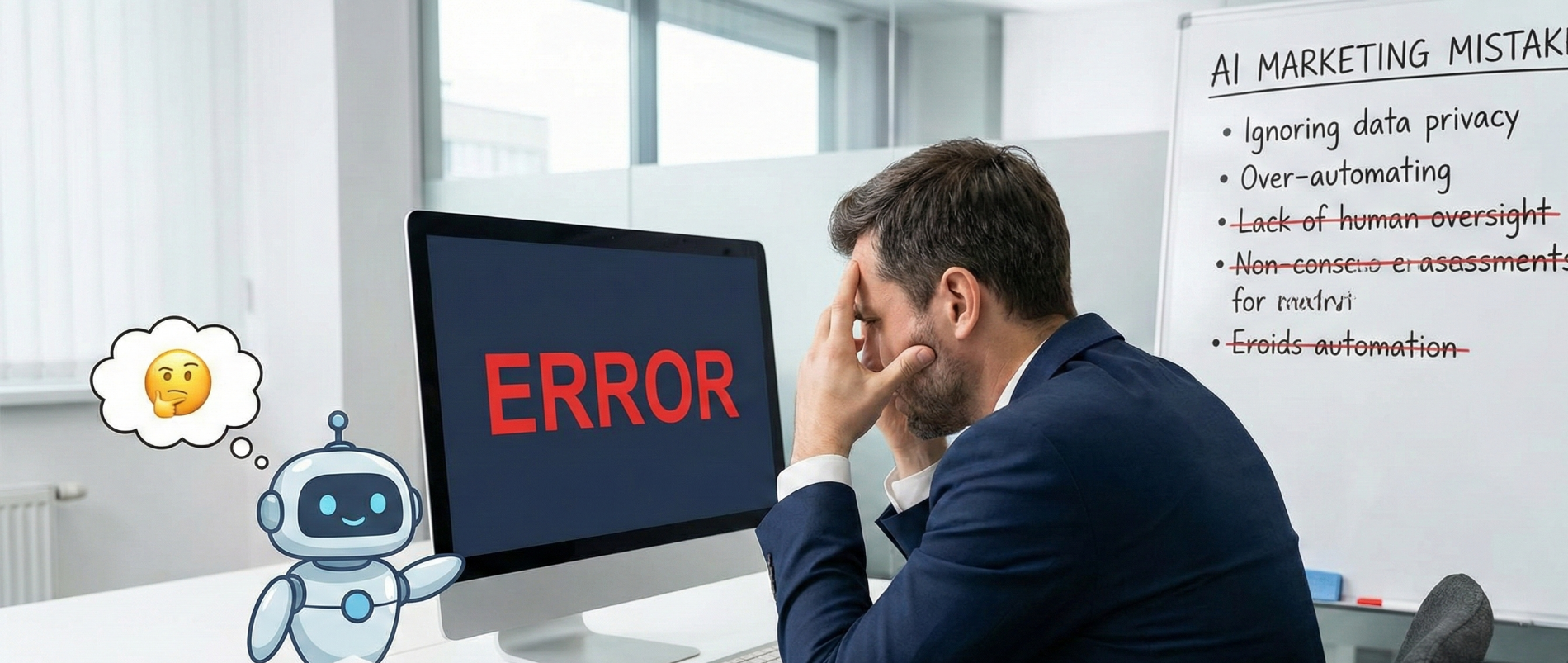
AI lacks human emotions, creativity, cultural sensitivity, and strategic judgment. Over-automation can make brand communication feel robotic, impersonal, and disconnected from real customer needs.
How to Avoid It:
Use AI as a support system, not a substitute. Let AI handle repetitive tasks such as data analysis, scheduling, and performance tracking. Humans should still guide strategy, storytelling, brand voice, and final decision-making. The best results come from a human + AI collaboration.
2. Using AI Without Clear Marketing Goals
The Mistake:
Businesses adopt AI tools simply because they are trending, without defining what they want to achieve—whether it’s lead generation, customer retention, or improved ROI.
Why It’s a Problem:
Without clear objectives, AI tools become expensive experiments with no measurable outcomes. This leads to wasted budgets and confusion.
How to Avoid It:
Before implementing AI, define clear goals:
- Do you want to increase conversions?
- Improve customer engagement?
- Reduce customer service response time?
Once goals are clear, select AI tools that align directly with those objectives and track results regularly.
3. Poor Quality Data Input
The Mistake:
Businesses feed AI systems outdated, incomplete, or inaccurate data.
Why It’s a Problem:
AI works on the principle of “garbage in, garbage out.” Poor data leads to flawed predictions, irrelevant recommendations, and ineffective targeting.
How to Avoid It:
Ensure your data is:
- Clean and accurate
- Updated regularly
- Collected ethically
Invest in proper data management systems and review data sources frequently to maintain quality.
4. Ignoring Customer Privacy and Compliance
The Mistake:
Some businesses collect excessive customer data without transparency or ignore legal compliance such as data protection laws.
Why It’s a Problem:
Privacy violations damage brand trust and can result in legal penalties. Customers are increasingly aware of how their data is used and expect ethical practices.
How to Avoid It:
Follow data protection regulations and clearly communicate how customer data is collected and used. Use AI responsibly and prioritize consent-based marketing. Ethical AI builds long-term trust and credibility.
5. Over-Automating Customer Interactions
The Mistake:
Businesses rely entirely on AI chatbots and automated replies, even for complex or sensitive customer queries.
Why It’s a Problem:
Customers may feel frustrated when they cannot reach a human for personalized assistance. This can lead to poor customer experiences and negative brand perception.
How to Avoid It:
Use a hybrid approach:
- AI chatbots for FAQs and basic queries
- Human agents for complex issues
This ensures efficiency without sacrificing empathy and service quality.
-
Expecting Instant Results from AI
The Mistake:
Many businesses expect immediate growth after implementing AI tools.
Why It’s a Problem:
AI systems require time to learn, optimize, and adapt. Unrealistic expectations lead to early abandonment of effective tools.
How to Avoid It:
Treat AI marketing as a long-term investment. Monitor performance, make adjustments, and allow time for algorithms to improve. Continuous testing and optimization are key.
7. Using Generic AI-Generated Content
The Mistake:
Businesses publish AI-generated content without editing, personalization, or brand alignment.
Why It’s a Problem:
Generic content fails to engage audiences and may hurt brand credibility. Search engines and customers value originality and authenticity.
How to Avoid It:
Always refine AI-generated content. Add brand tone, real examples, local context, and emotional elements. AI should assist creativity, not replace it.
8. Lack of Team Training and Awareness
The Mistake:
Businesses introduce AI tools without training their marketing teams.
Why It’s a Problem:
Teams may misuse tools, misunderstand insights, or underutilize AI capabilities.
How to Avoid It:
Invest in training programs and workshops. Ensure your team understands how AI tools work, their limitations, and how to interpret results effectively.
Conclusion
AI marketing offers incredible potential, but success depends on how it is used. Businesses that treat AI as a strategic partner—rather than a magic solution—gain the most value. By avoiding common mistakes such as over-automation, poor data practices, and lack of human oversight, companies can unlock smarter campaigns, better customer experiences, and sustainable growth.
In the future, brands that balance technology with human intelligence will stand out in an increasingly competitive digital landscape.