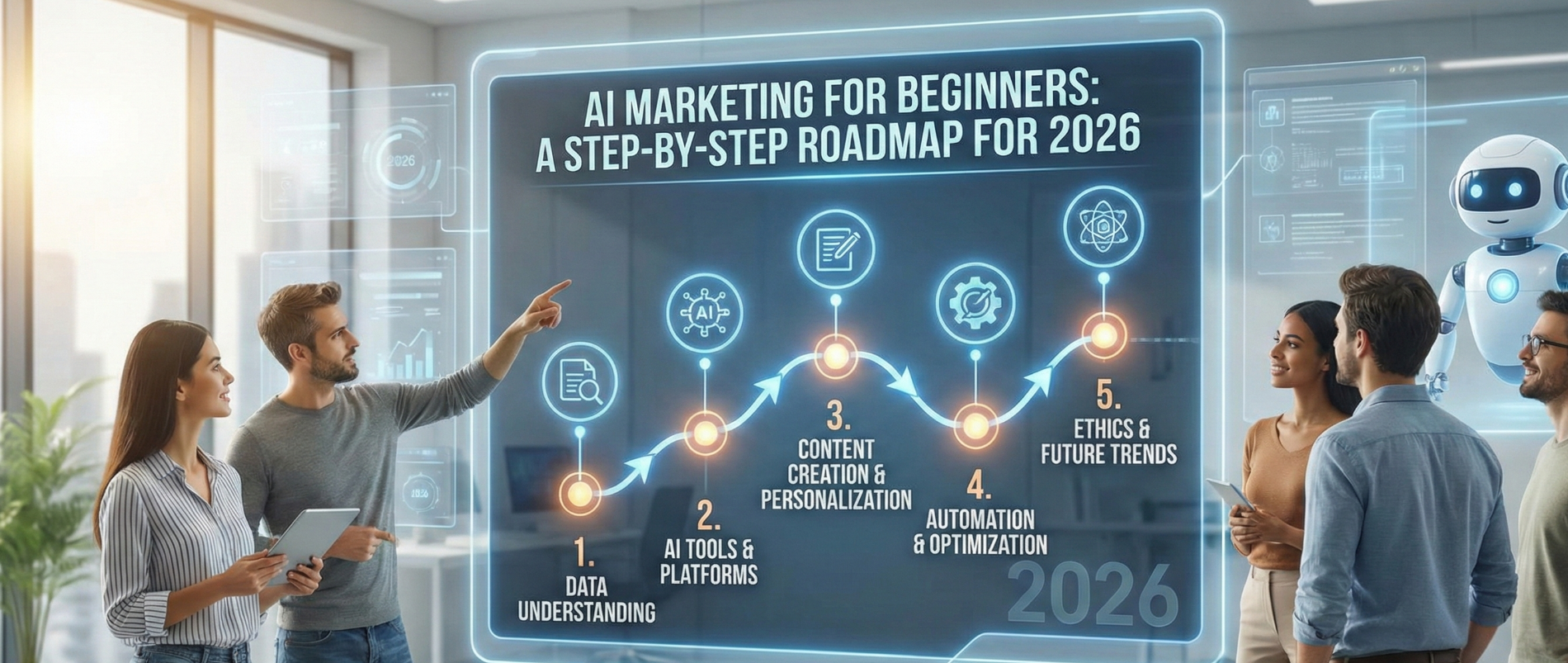
AI Marketing for Beginners: A Step-by-Step Roadmap for 2026
Marketing is evolving faster than ever. As we move toward 2026, Artificial Intelligence (AI) is no longer a futuristic concept—it is a practical, everyday tool transforming how businesses attract, engage, and retain customers. From personalized ads to automated content creation and predictive analytics, AI is reshaping the entire marketing ecosystem.
For beginners, AI marketing may sound complex or intimidating. However, the reality is that AI tools are becoming more accessible, affordable, and user-friendly. This blog provides a clear, step-by-step roadmap to help beginners understand AI marketing and confidently start using it in 2026.
What Is AI Marketing?
AI marketing refers to the use of artificial intelligence technologies to automate, optimize, and enhance marketing activities. These technologies analyze large amounts of data, identify patterns, and make decisions or recommendations with minimal human intervention.
AI marketing helps with:
- Understanding customer behavior
- Creating personalized experiences
- Optimizing campaigns in real time
- Predicting trends and outcomes
- Saving time and reducing manual work In simple terms, AI acts as a smart assistant that helps marketers make better decisions faster.
Why AI Marketing Is Essential in 2026
By 2026, digital competition will be more intense than ever. Customers will expect personalized experiences, instant responses, and relevant content across all platforms. Traditional marketing methods alone will not be enough.
AI marketing will be essential because it:
- Handles large data volumes efficiently
- Delivers hyper-personalized messaging
- Improves return on investment (ROI)
- Enables real-time decision-making
- Scales marketing efforts without increasing costs Businesses that adopt AI early will gain a strong competitive advantage.
Step-by-Step Roadmap to Start AI Marketing
Step 1: Learn the Basics of AI and Data
Before using AI tools, beginners must understand the fundamentals.
- What AI is and how it works
- The importance of data in marketing
- Basic concepts like machine learning, automation, and analyticsYou don’t need to be a technical expert. A conceptual understanding is enough to get started and use tools effectively.
Step 2: Define Clear Marketing Goals
AI works best when goals are clearly defined. Beginners should ask:
- Do I want more leads?
- Do I want higher conversions?
- Do I want better customer engagement?
- Do I want to reduce marketing costs?Clear objectives help in choosing the right AI tools and measuring success accurately.
Step 3: Start with AI-Powered Content Creation
Content is the foundation of digital marketing, and AI makes content creation faster and more scalable.
Beginners can use AI for:
- Blog writing and article outlines
- Social media captions and posts
- Email marketing content
- Ad copy and landing page text AI tools can generate drafts quickly, while humans refine creativity, tone, and brand voice.
Step 4: Use AI for Social Media Marketing
Social media is time-consuming, and AI simplifies management.
- AI suggests the best posting times
- Generates content ideas and captions
- Analyzes engagement and performance
- Helps identify trending topicsBeginners can maintain consistent social media presence without spending hours daily.
Step 5: Implement AI in Email Marketing
Email marketing remains one of the highest ROI channels—and AI makes it smarter.
- AI personalizes subject lines and content
- Automates email sequences and follow-ups
- Predicts the best time to send emails
- Segments audiences based on behavior .This leads to higher open rates, click-through rates, and conversions.
Step 6: Adopt AI for Paid Advertising
AI-driven advertising platforms are essential in 2026.
- AI optimizes ad targeting and bidding
- Tests multiple creatives automatically
- Allocates budget to high-performing ads
- Improves campaign performance in real timeEven beginners can run effective ad campaigns with AI support.
Step 7: Use AI for Analytics and Insights
Data analysis is one of AI’s strongest capabilities.
- AI dashboards track campaign performance
- Predictive analytics forecast future trends
- Customer insights reveal buying behavior
- Reports are generated automatically Instead of guessing, marketers make data-driven decisions.
Step 8: Enhance Customer Experience with AI
AI improves customer engagement and satisfaction.
- Chatbots provide instant customer support
- AI recommends products or services
- Personalization improves customer loyalty
- Sentiment analysis tracks customer feedback
Happy customers lead to repeat business and brand advocacy.
Step 9: Combine Human Creativity with AI Intelligence
AI is powerful, but it is not a replacement for human creativity.
- Humans define strategy and vision
- AI handles execution, optimization, and analysis
- Creativity, empathy, and storytelling remain human strengths . The best results come from collaboration between humans and AI.
Skills Beginners Should Develop for AI Marketing
To succeed in 2026, beginners should focus on:
- Basic data literacy
- Prompt writing and tool usage
- Marketing fundamentals
- Analytical thinking
- Adaptability and continuous learning
AI tools will change, but core marketing principles remain timeless.
Common Mistakes Beginners Should Avoid
- Expecting AI to work without strategy
- Ignoring data quality
- Over-automation without human review
- Using too many tools at once
- Not testing and optimizing regularly
- AI is most effective when used thoughtfully.
The Future of AI Marketing
By 2026, AI marketing will become:
- More personalized and predictive
- Voice- and video-driven
- Integrated across all channels
- Accessible to businesses of all sizesMarketers who start learning and experimenting today will be well-prepared for the future.
Conclusion
AI marketing is no longer optional—it is a core skill for modern marketers. For beginners, the journey starts with understanding basics, setting clear goals, and gradually adopting AI tools across content, social media, ads, email, and analytics.
By following this step-by-step roadmap, beginners can confidently enter the world of AI marketing in 2026—working smarter, delivering better results, and staying ahead in an increasingly competitive digital landscape.
The future of marketing belongs to those who know how to use AI wisely.